‘ALBUM OF MEMORIES’
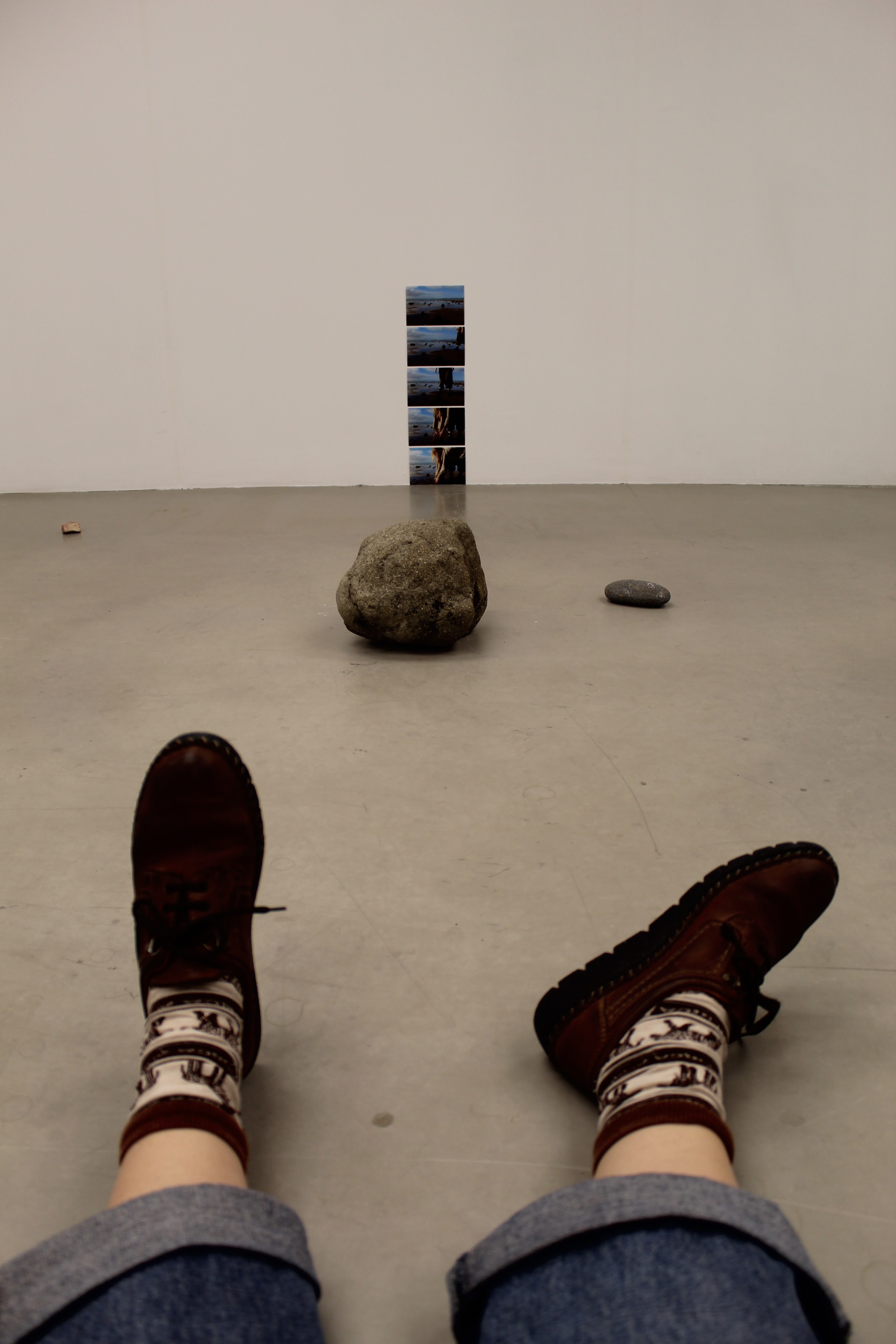
The art installations that follows in ‘The Album of Memories,” begun from a place of experimentation prior the commitment I made to work that considers the nature of collecting.
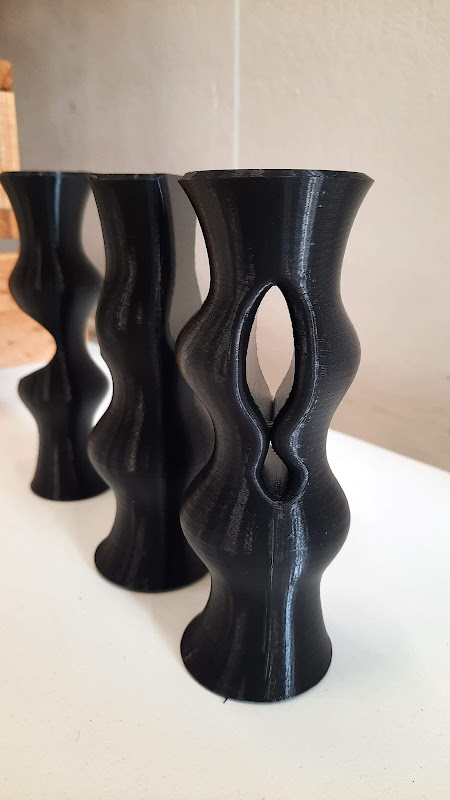
Initial Experimentation: I experimented with digitally fabricated skills of making. I found an in interest in representation. I begun trying to represent the organic forms of bamboo with 3D Printing. Following this I attempted to represent the sound that bamboo made, specifically bamboo chimes. I then moved from merely representing to an attempt at enhancing the sound of bamboo chimes using digitalized methods such as laser engraving/cutting.
This path of experimentation stopped abruptly after engraving into a single piece of bamboo. However, the ideas and interest in the sound quality within a material and an artwork stayed. I took representing literal objects to a topic of greater significance to me. Using sound to represent the phycological state of relationship a person may hold between them and an object/ material.
Travel Back in Time: For a moment we must look back to a prior work of mine, ‘The Fallen Branches of Tai Wairua.’ The final work I made was a bespoke storage system for a collection of sticks. The work held the driftwood and sticks within the hierarchical structure of I, the collectors value system. The sculpture clearly displayed the high value I personally placed on the sticks over other material such as finally crafted wood.
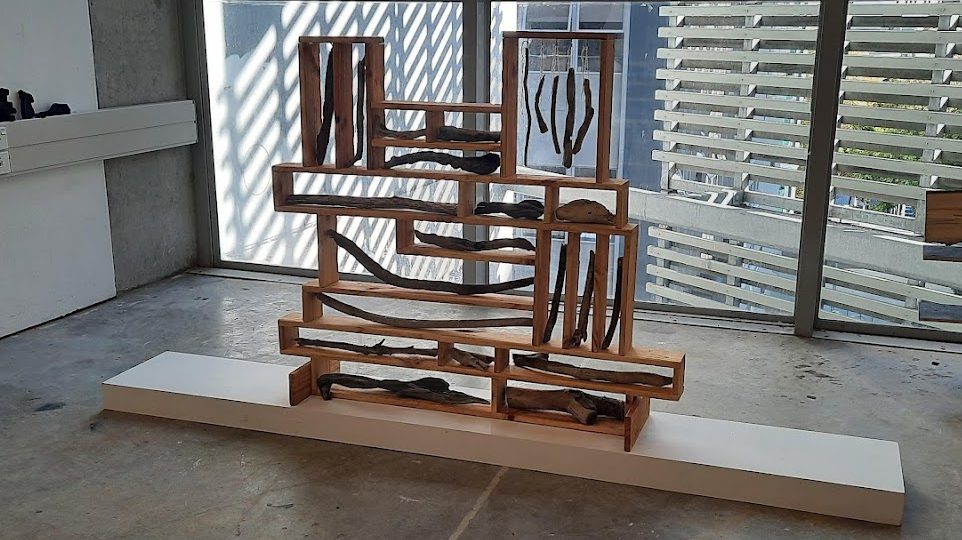
I have referenced this work as I approach The Album Of memories as it is a precursor to A collection of stones that is also held in high regard by myself, the collector.
Springboard Artist: The artist Phil Dadson unlocked the sonic possibility of stones within my realm of knowledge. It was through this eye opening work that I begun to see the possibilities that a stagnant medium can hold.
A Time For Questioning And Discovering:
I have been collecting seriously as a part of my everyday life over the past five years. Collecting is a concept that is very familiar to many people. I believed prior to an research that collecting is an innate quality of being a human. Collecting looks different for every collector. Just as there are many artists in the world, there is no two the exact same. Many people collect stones though no one has collected that stones I have collected.
I asked the question, why do we collect? What drives a person to want to collected a specific item? For a stone collector, why would a collector choose the chosen rock over the possible thousands that lay before them? These questions led my research into phycology’s and philosophies behind collecting.
A specific area of engagement has been concept of value in relation to the collector. How value systems are linked to the archival nature of human kind – This innate desire to take hold of an object – To collect. Through my work I am opening a lens to view the innocent collector. Mankind’s collections and present archives of Nature’s creations.
Formalize My Explorations: Wanting to applying the ideas I had brewing in terms of creating artwork to support my interest in the relationship between the collection and the collector. I made a road map- a guiding plan to lead my forward. The direction allows for a my ideas to build on each other, rather than my ideas spreading out in different directions.
This was the way I wanted to work- a closed approach. Through the initial plan I have made I am able to do the directed task to a higher level of revision.
Artwork 1 :


Bringing in my parts of my stone collections into the studio help my to take the personal collection from a its intimate value that it has in my personal life and bring it into a new context. My art work inevitably holds value to me though I get to choose the extent in which I share myself. In this case the memories that the rock held were not ever retold within the work. I made this decision from the get go as it was important that the art work were not a reflection on me but on the identity of a collector.
In addition to this decision I choose to go on a rock collecting walk at Tai Wairua to gather rock that held memories that I felt comfortable to place in a public place.
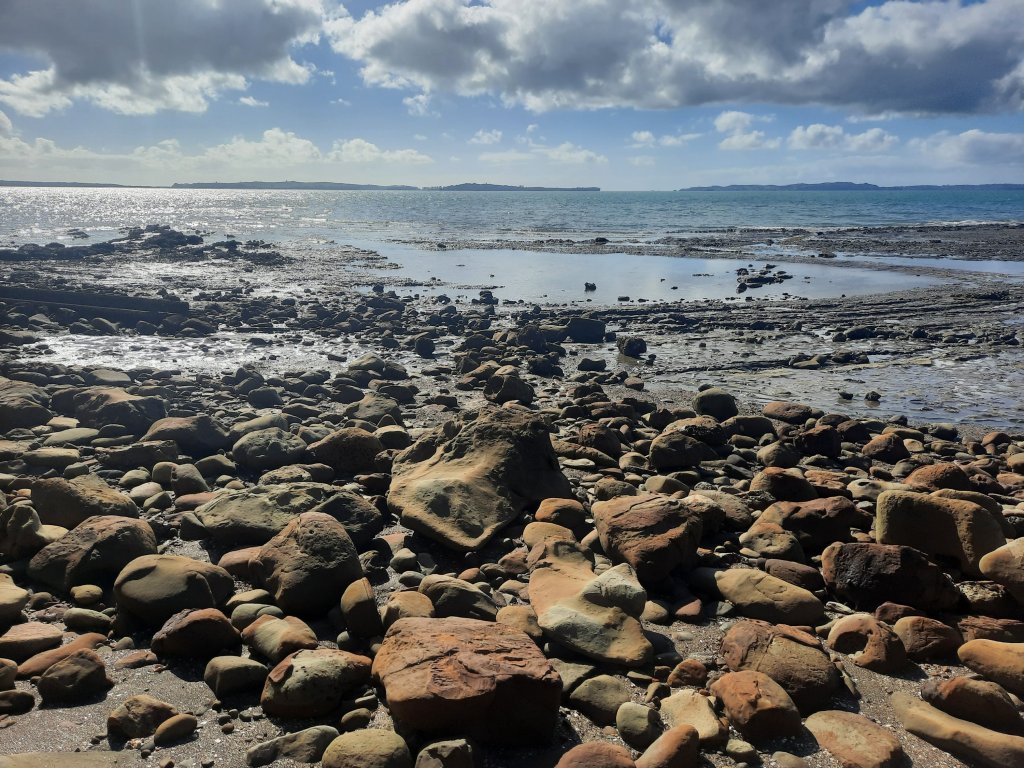

Whilst I spent some time at the beach I recorded a sound work with an old freshly fallen Pohutakawa tree and a stone. this work would kick start my series of sound recording to come.
I worked on a sound piece that included five recording on a mixtape. I digitally manipulated the sounds on the mixtape to evoke a physical response from the audience. I want the sounds that I use in my installations to not just accompany the work but create an experience and perspective that otherwise would not have been realized.
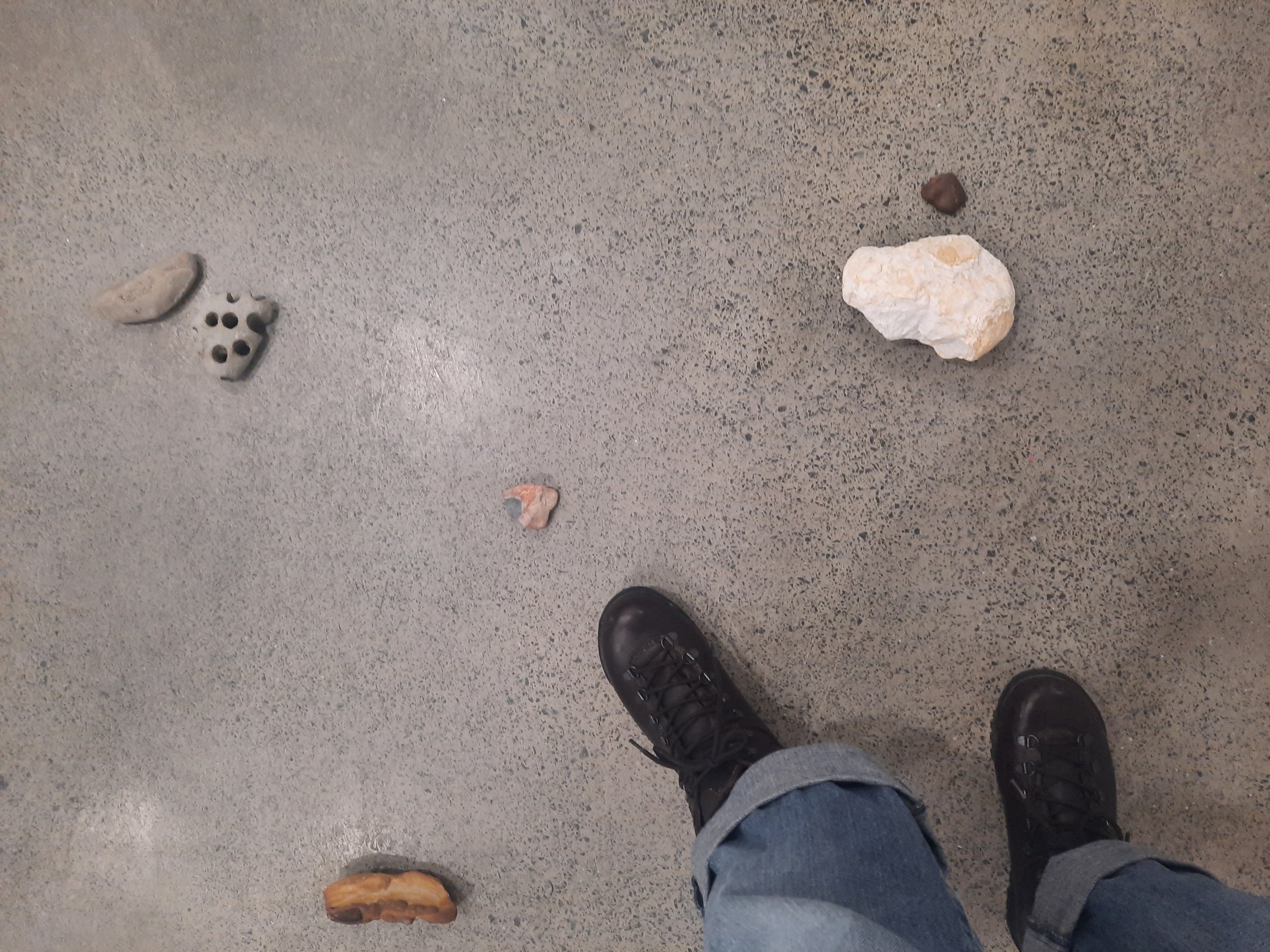
When considering the installation with the sound playing the room I imagined the rocks in a glorified state. Through my lens in biblical backgrounds I exercised an idea around a stone alter – a sacrifice to memory. This idea was a loaded and held a loud voice in an of itself outside of the collector an the collection. For this reason I chose to step back from that idea. Instead I found myself giving each stone in the installation a great deal of space to surround it as an individual.
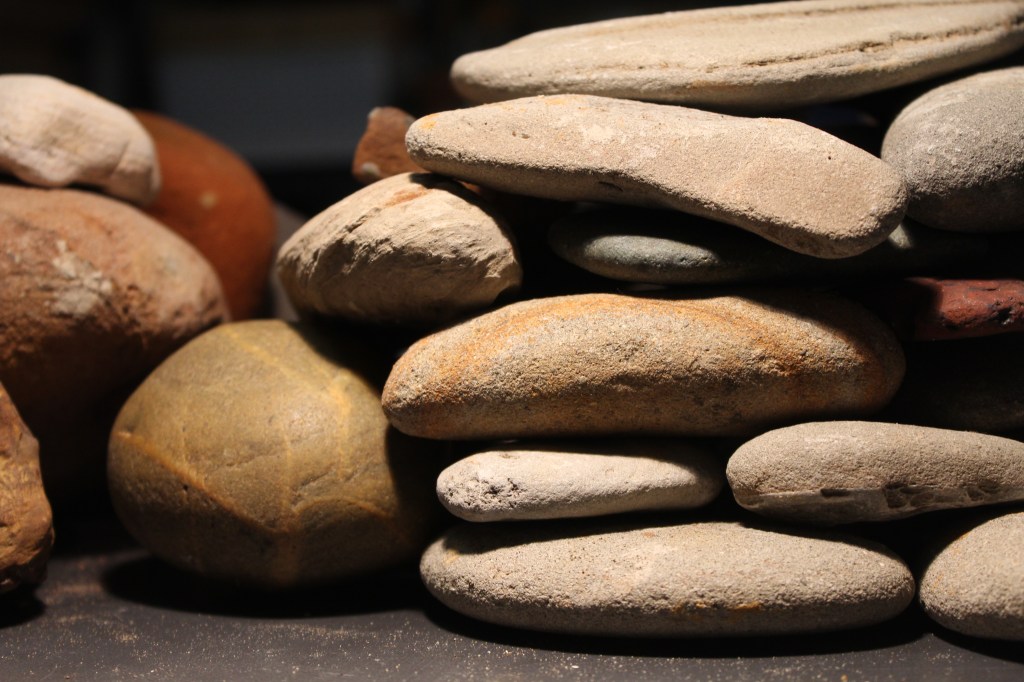

Formalizing my studio practice into an installation: Installations require a greater thought as the artwork is not just the item but the entire space you are situated in creates the art encounter. each object in the room and the space between the objects impacts the the viewer’s experience and the ideas portrayed. Where you stand/ lay/ sit in a space directs your experience guides ones interpretation of the said artwork.
Janet Cardiff: Knowing how easy it is to make an error when starting out with installations, especially sound work I have taken guidance from well known sound sculptural artist Janet Cardiff.
The concept that sound can be viewed through a sculptural lens, ideas around three-dimensional sound. Janet Cardiff is known for the vulnerability that she is able to provoke in her audience by the her curation of sound.
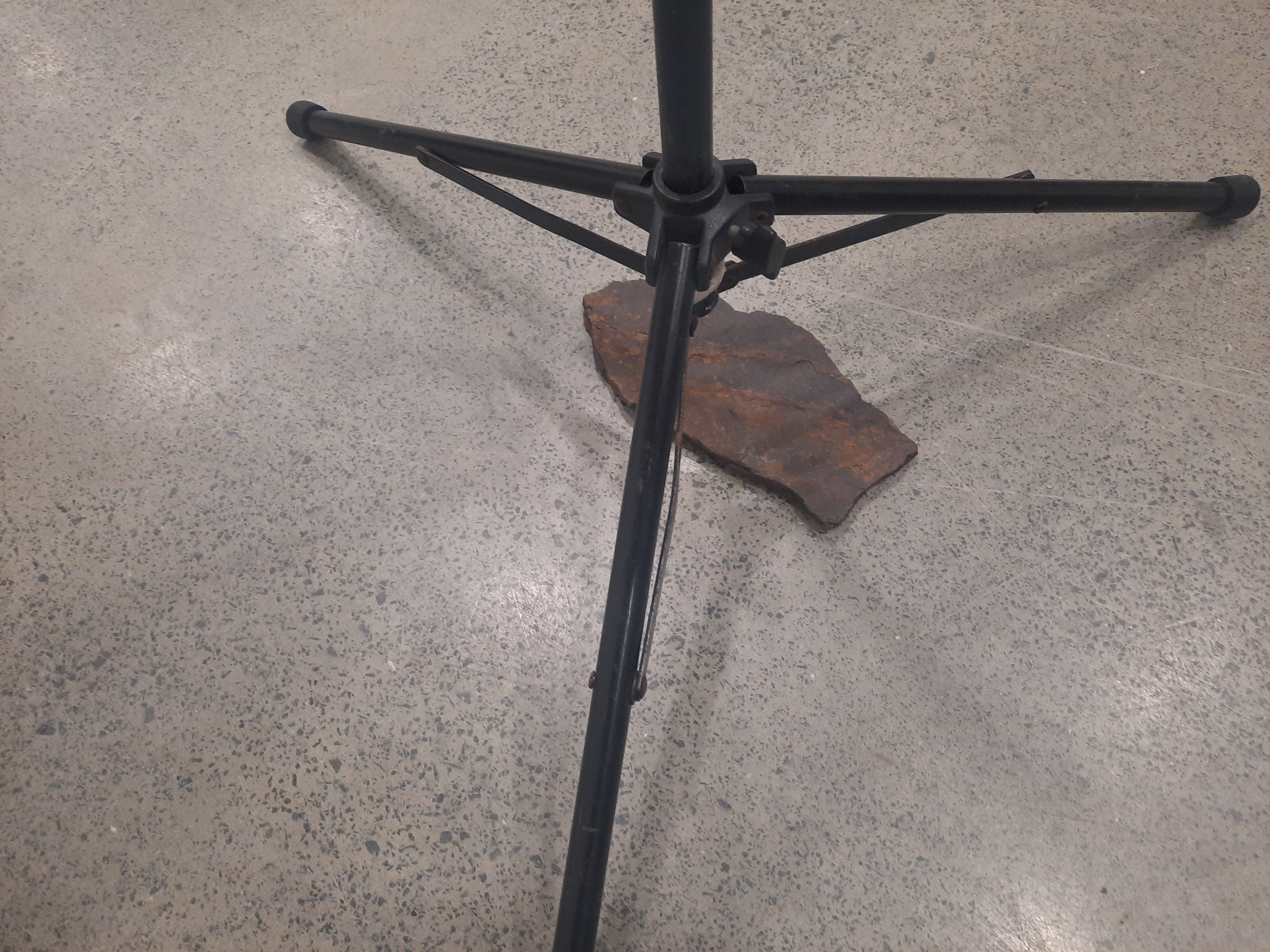
A specific idea that I draw from the placement of speaker in ‘The Forty Part Motet’ was the personified role that each speaker took on. I wanted to have speakers that also met you in your upright position. When walking up to or past a speaker within an audio installation it is as though you are walking my a person speaking.

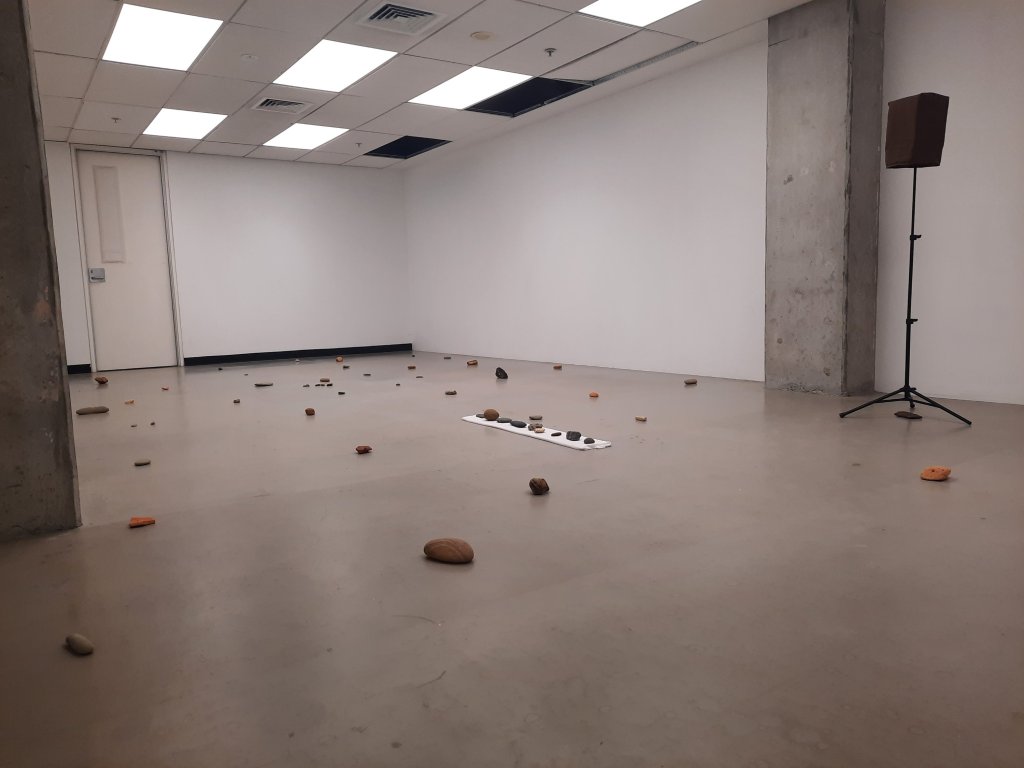
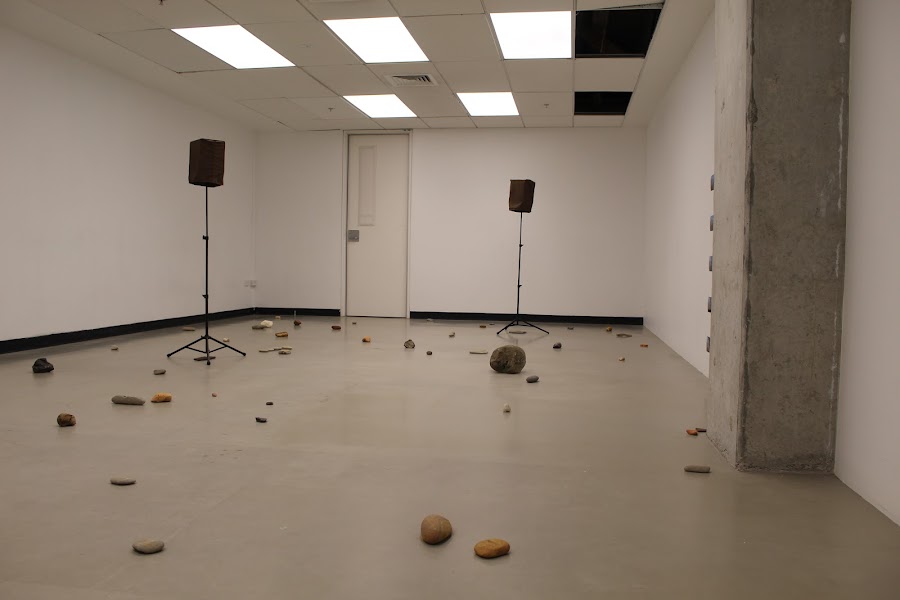
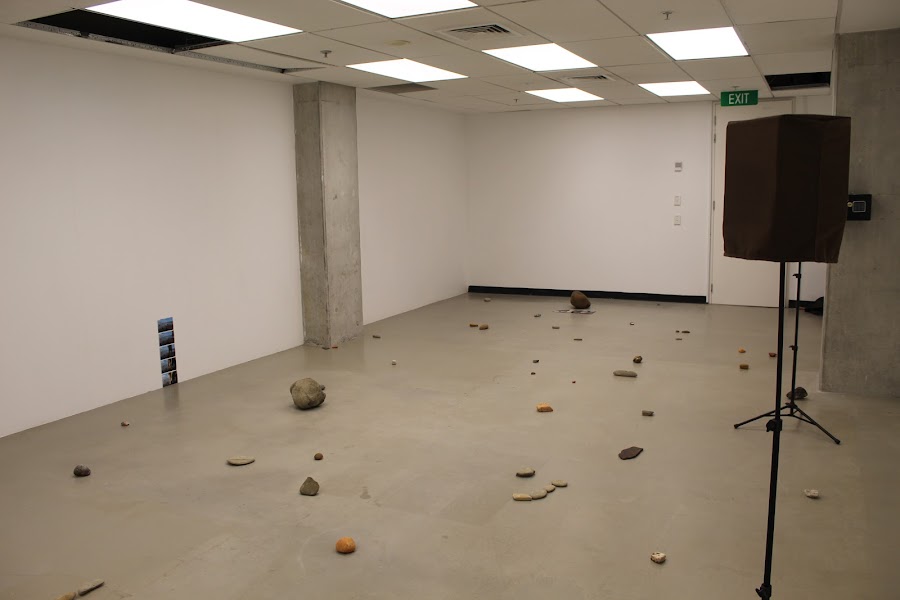
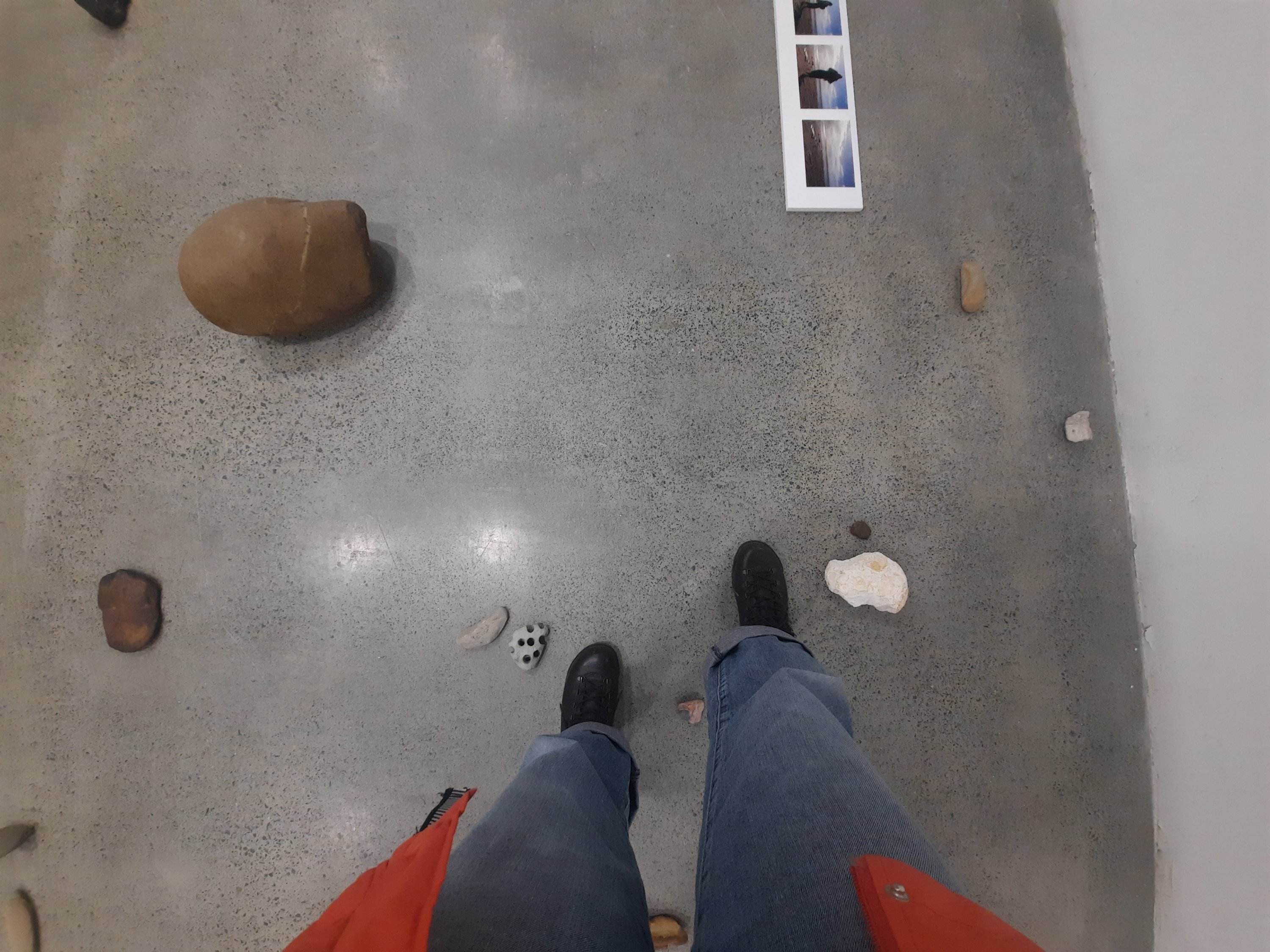
Bringing my discoveries into an installation I used one speaker to play the digitalized stone sounds. In the center of the room I have brought attention to a specific set of rocks used to create the sonic sounds by placing them on a fabric white board. Throughout the room I have thoughtfully placed the stones in relation to marks made within the room prior to me using it. Creating space for each rock to rest I have clearly identified to the audience the value placed on the stones.
The sound emits as an unseen layer resting over the seen rocks. It is through this dynamic relationship that I have created an experience in my installation. I wish to see the audience engage with a sense of wonder as they listen to the sounds played. What so the sounds and rhythms evoke when considering stones. In many regard the stones scattered throughout the installation are in essence, scattered memories.
Artwork 2 : Photography & sound – Video work
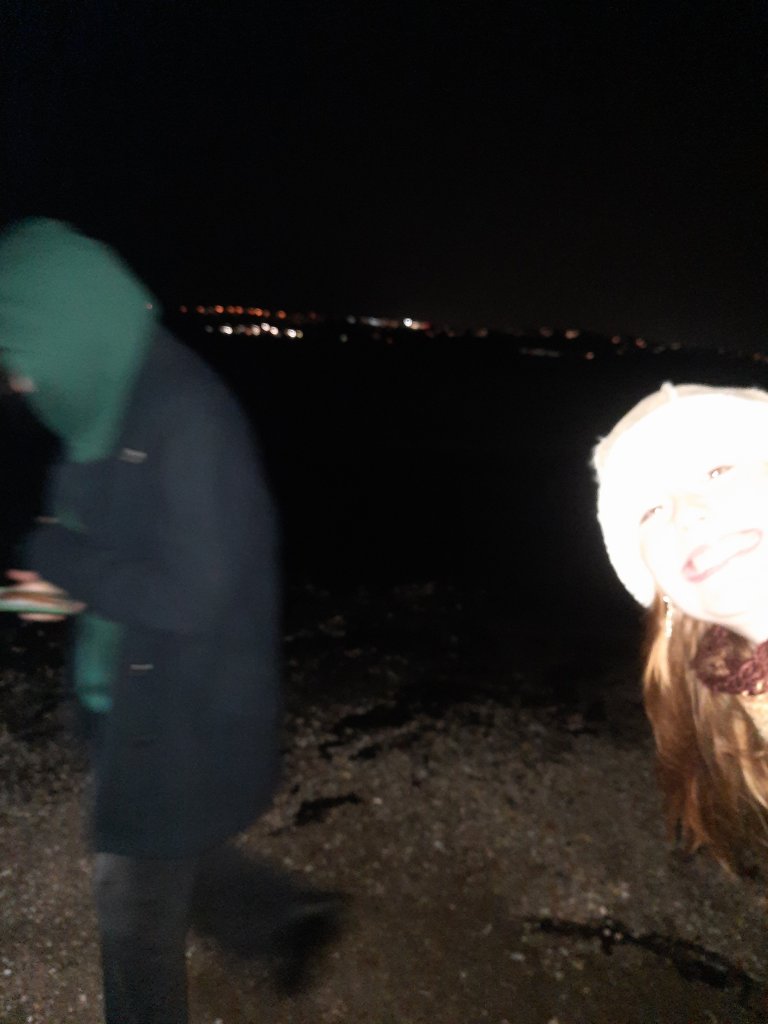

Moving to a video work – I took my mates for a beach excursion. Whilst we were there all my friends collected a selection of shells, rocks and any litter we found at the beach.
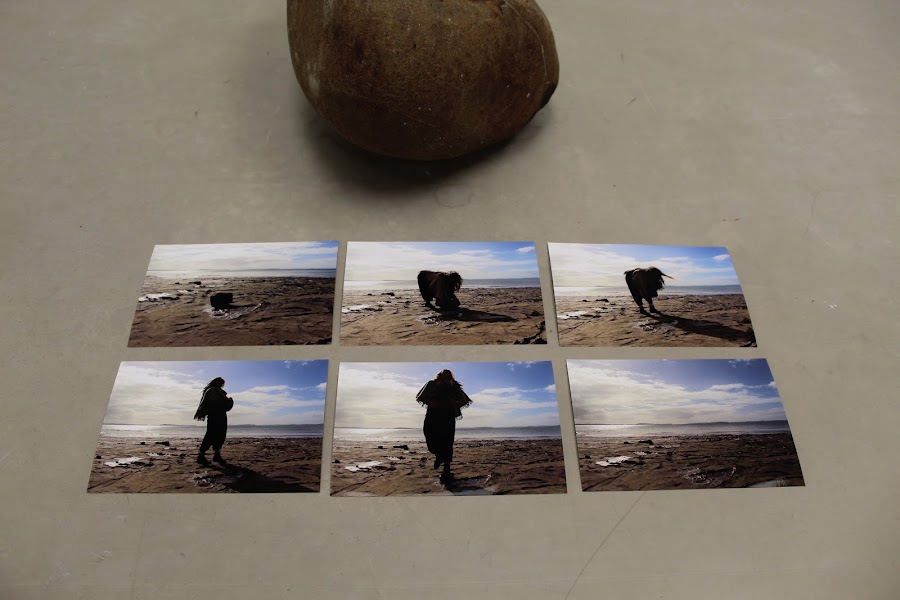
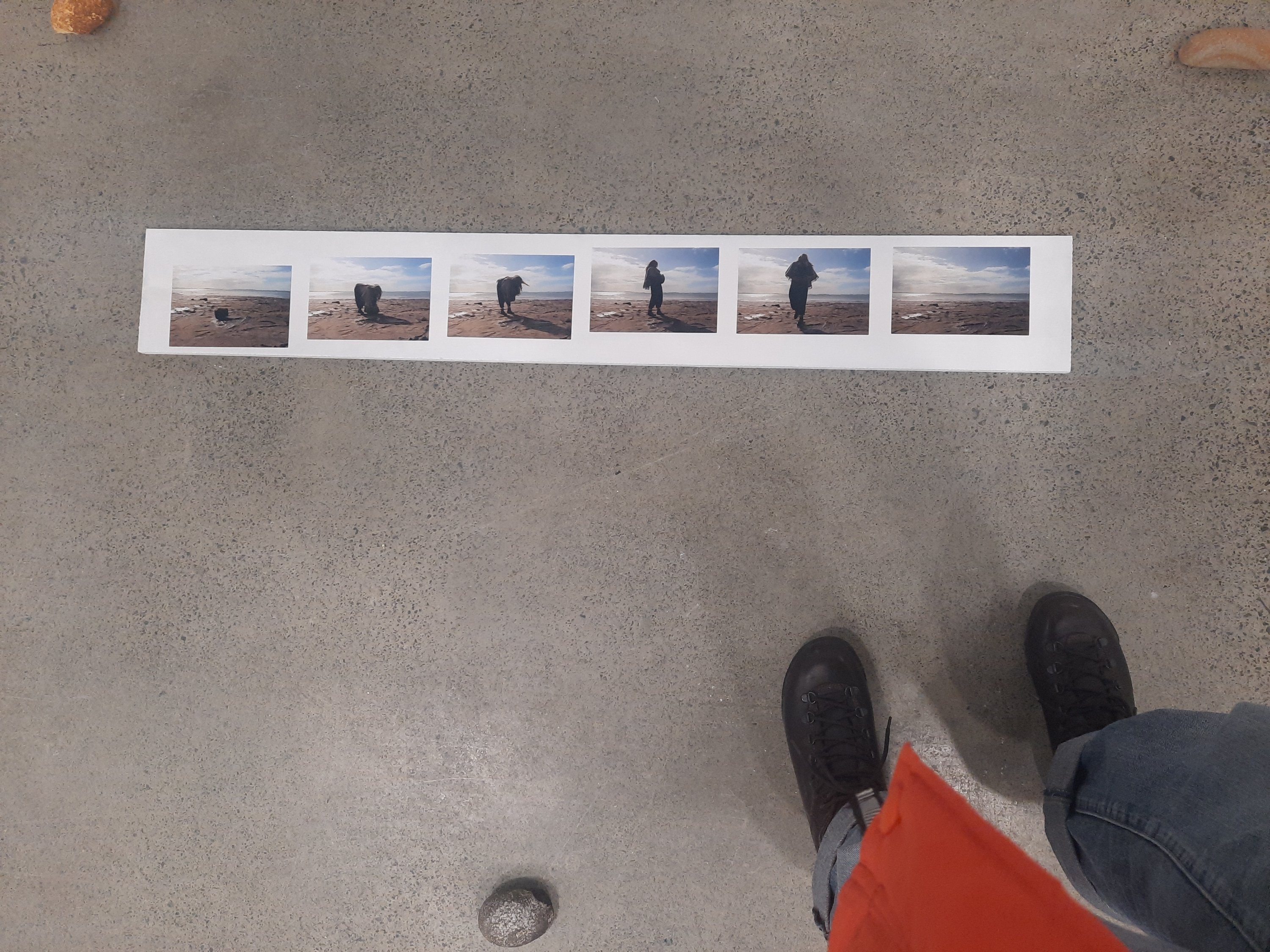
I took a photo of a friend prior to picking up a rock. this photograph in many ways captures a memory is a similar way that the rocks in my personal collection capture memory.
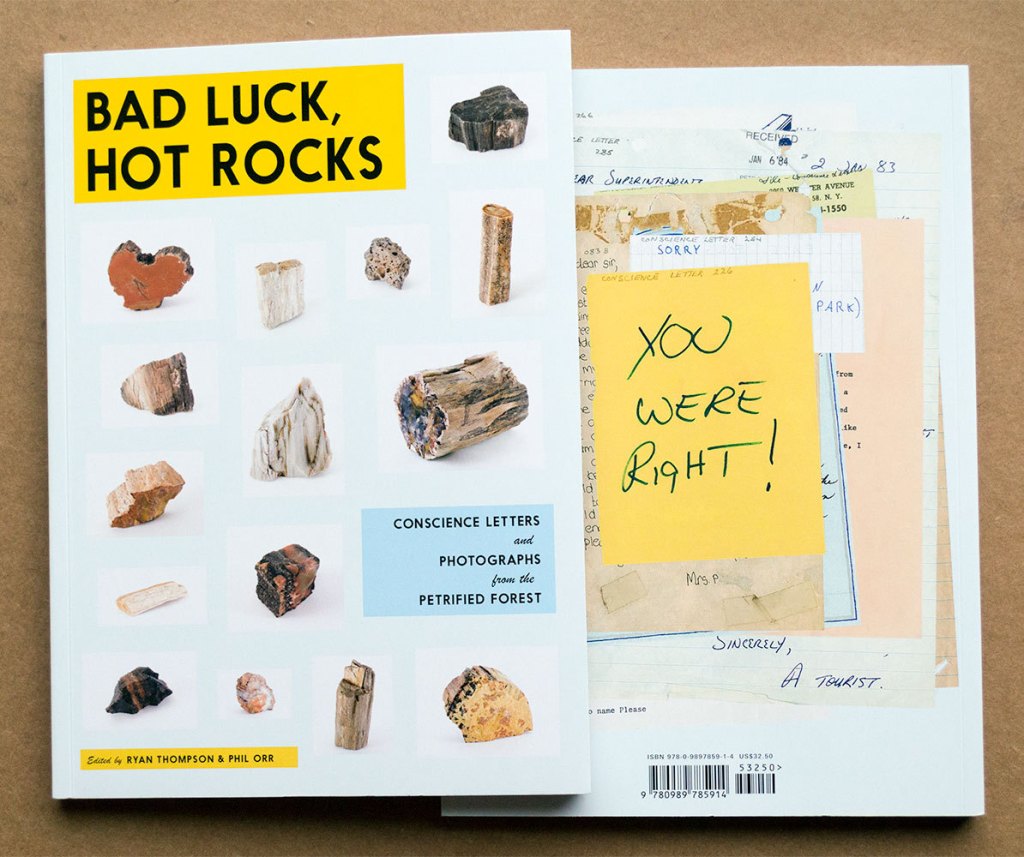
I wanted to extend the act of revealing to the metaphysical realms of collection. Thinking into this is both phycological, but I as an additional layer to the piece I waned to acknowledge the metaphysical, perhaps spiritual reality of collecting.
An interesting addition to spiritual ideas or concepts around rock is the legends around the rocks at Petrified Forest National Park in America. In a book “BAD LUCK, HOT ROCKS” the curator has put together a collection of conscience letters from visitor who have take so called, ‘cursed rocks’ home with them.
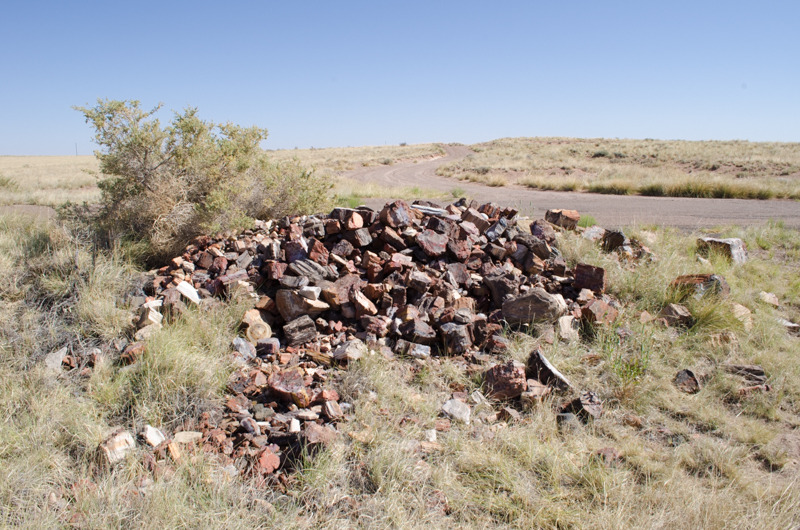
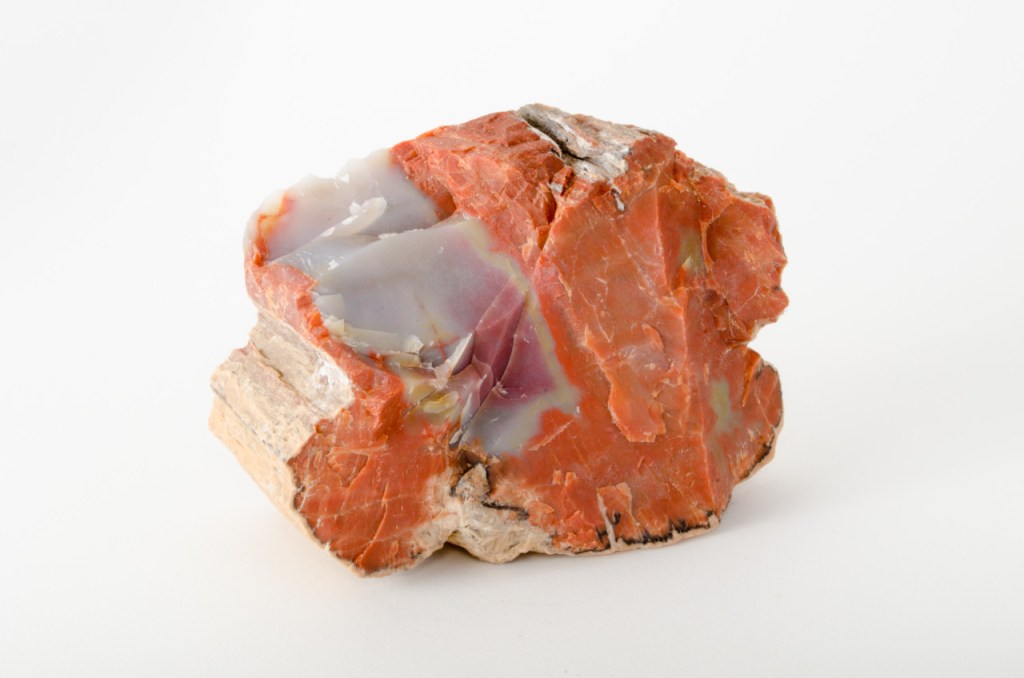
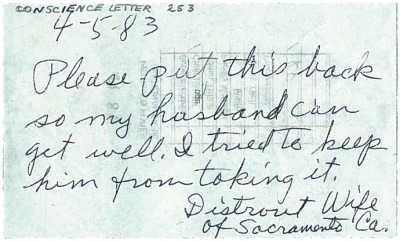
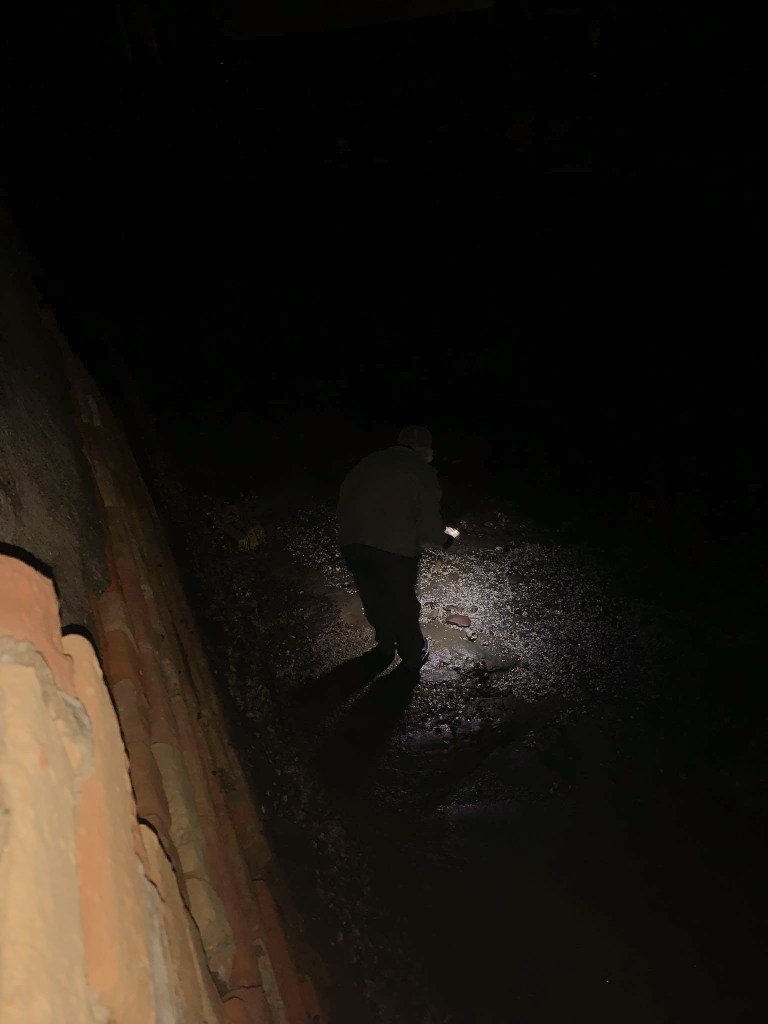
The constant rhythm made by the rock ( 1,2,1,3.) has stilled the photograph. I wanted to reveal the audience to the memory that was captured through the collecting of a rock and through the camera lens. In many regards the point of collection, when the collector meets the thing to be collected. This is where the time based aspect of my studio practice is visualized. there is a consistent attempt to capture moment in time trough each and every stone. Note: The stone in the image is the same stone making the sounds in the video work.
Artwork- 3 : Sound and Photographic Context.
Moving from a single photograph I wanted to develop the ideas around sound and is ability to personify and create empathy to a thing, whether this be land or stone.
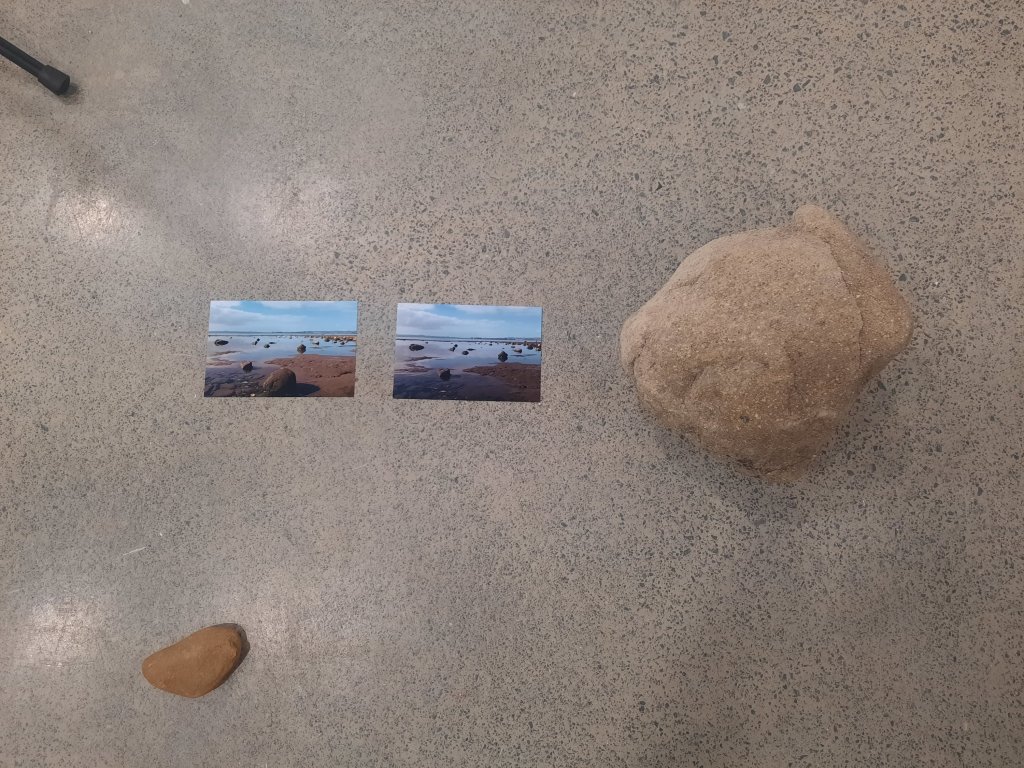
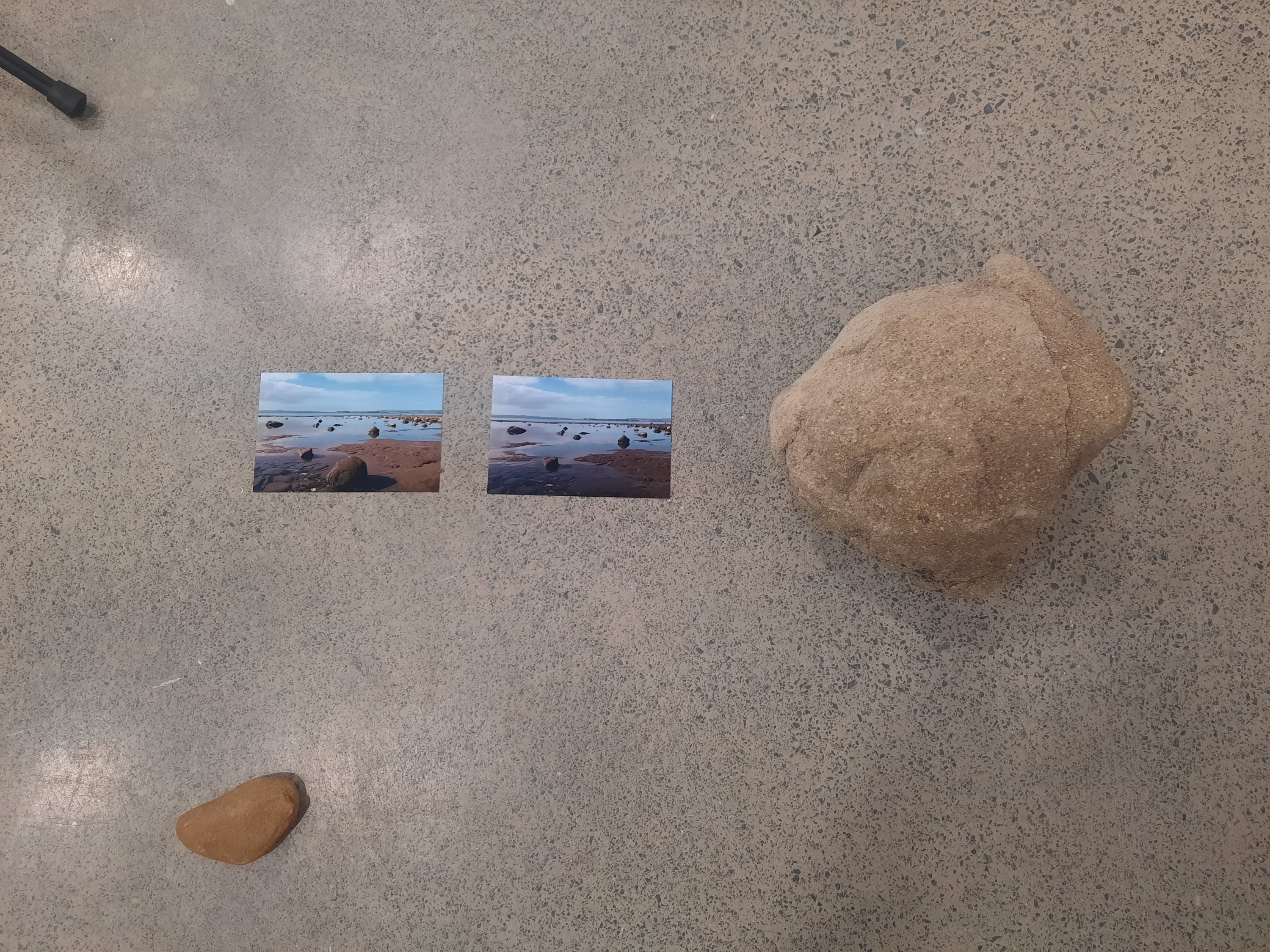
For this installation piece I wanted to introduce photography to initial idea of revealing the space between the collector and the collection. Photographing this process gives context to the act of collection and to the land the stone, rock or boulder is collected from.
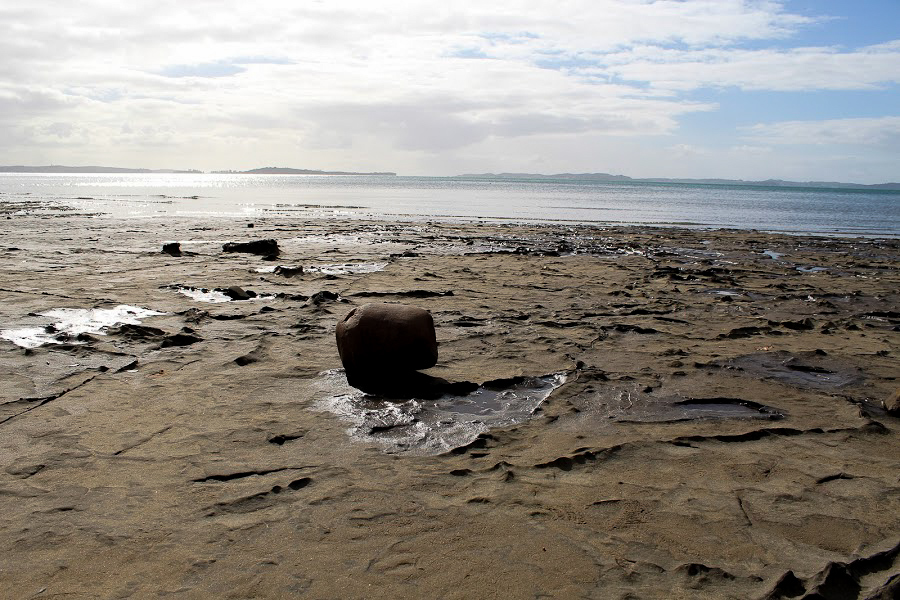

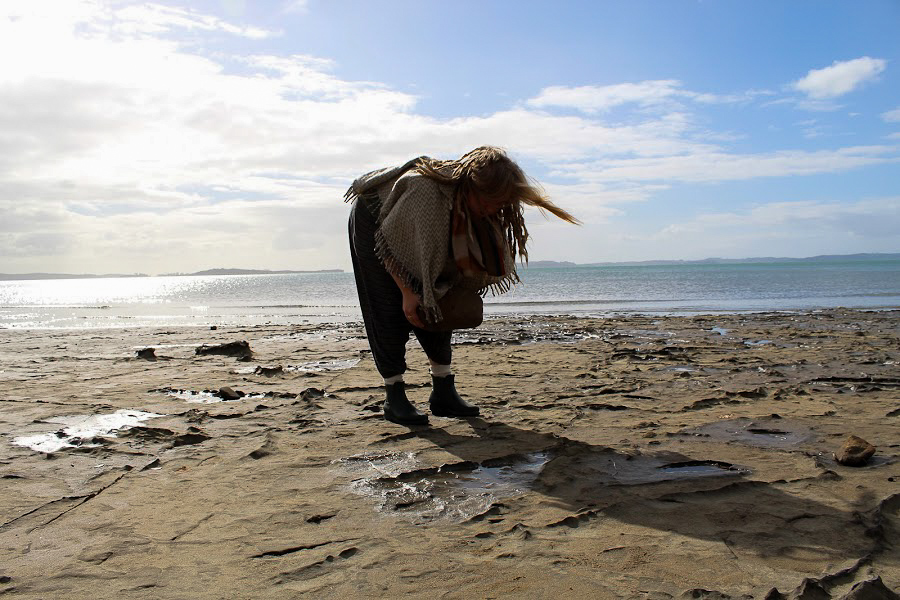
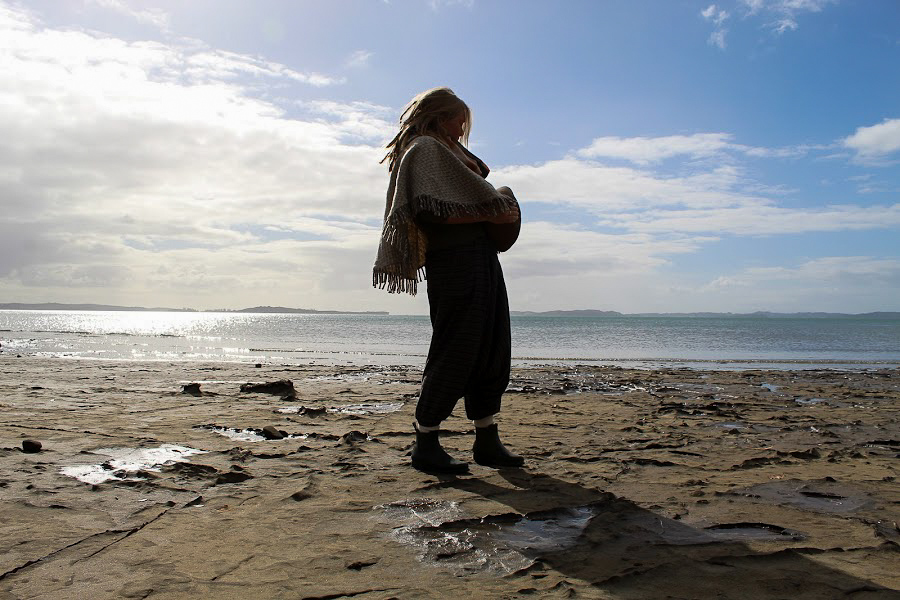
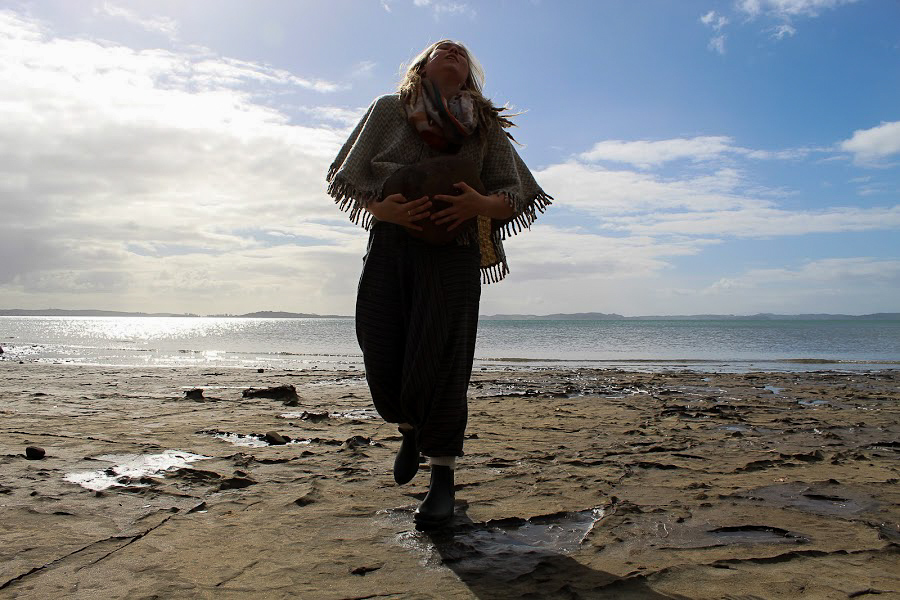
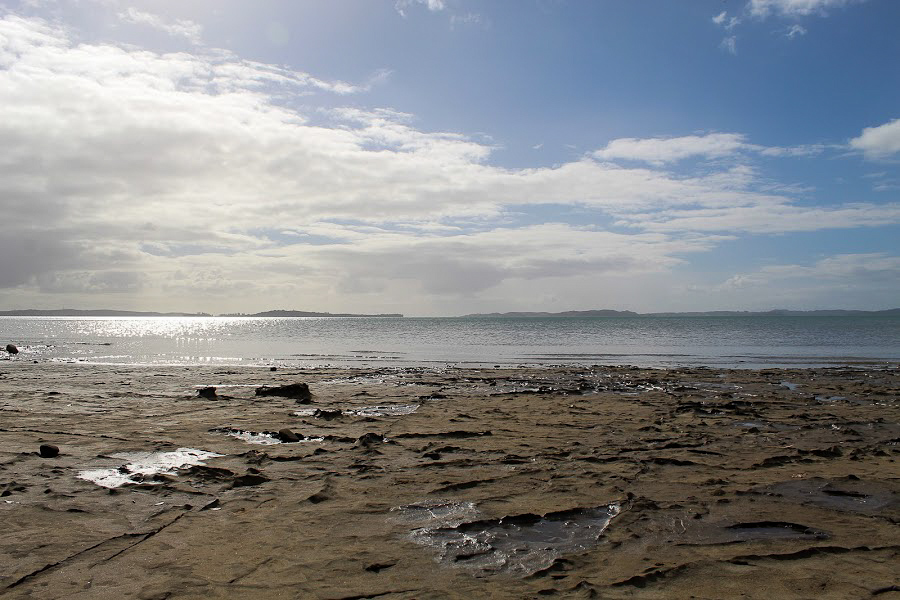

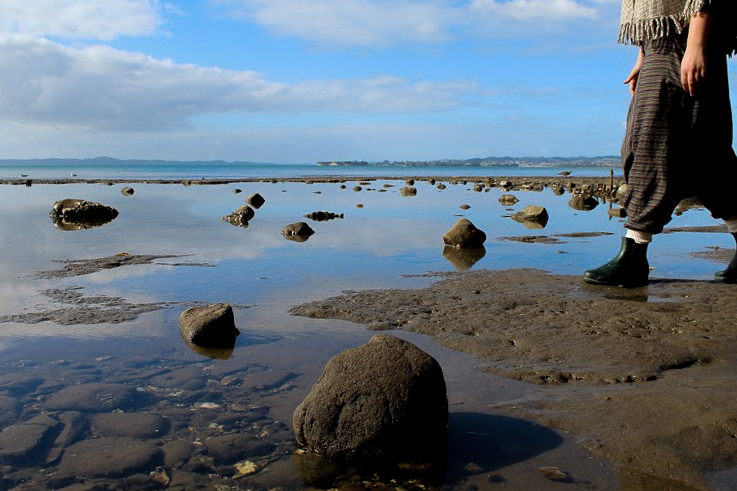
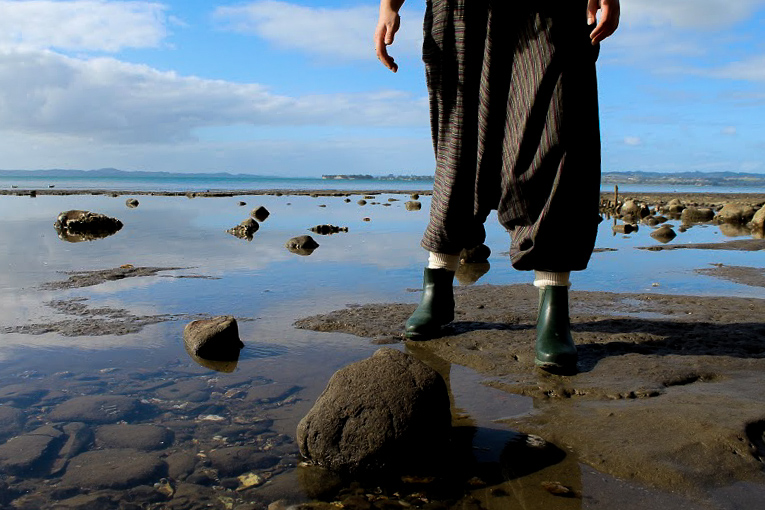
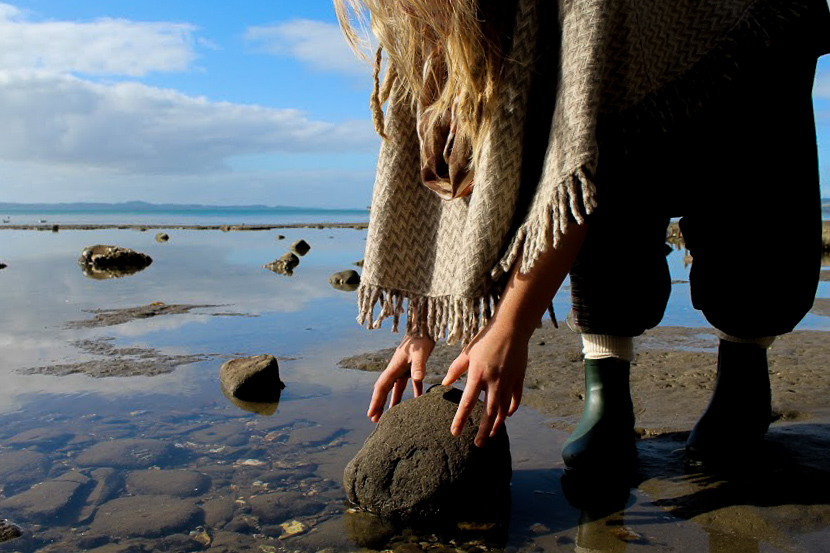
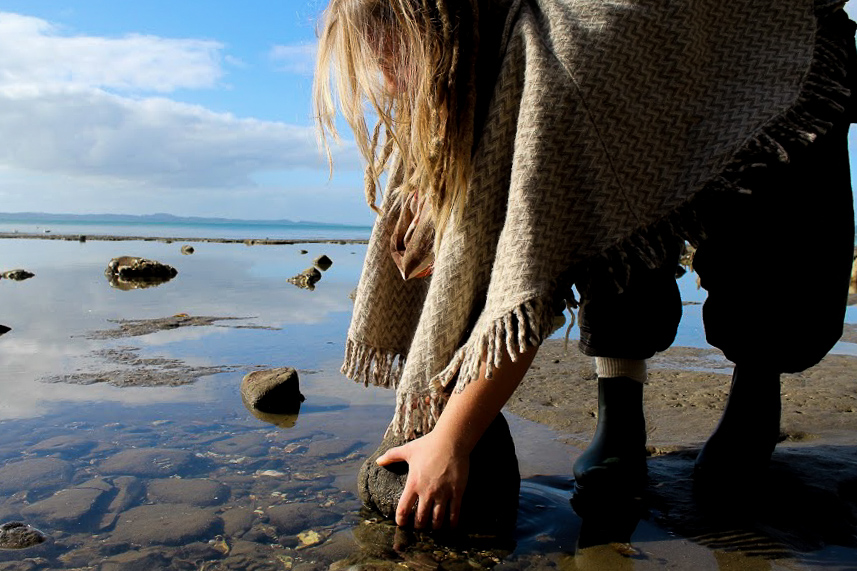
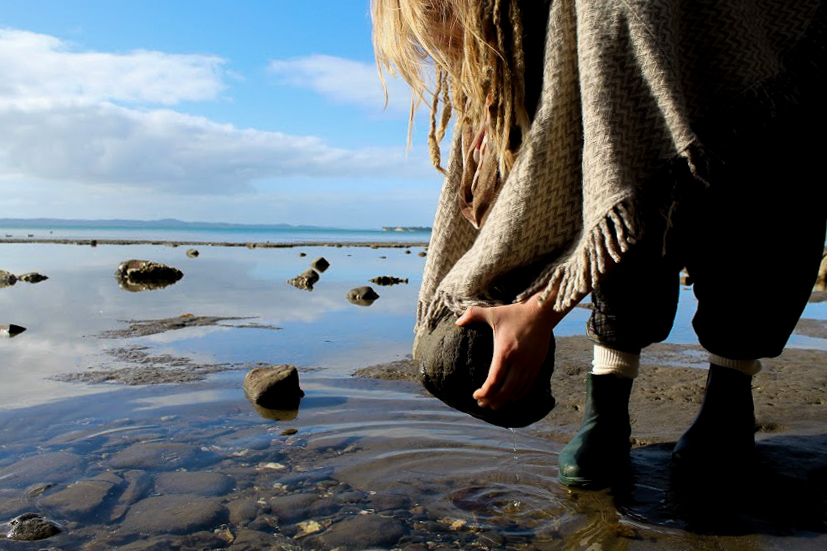


As I photographed my work at the bay I found the innocence of collecting had been taken from me in an ultimate state. I’m many regards I felt I was stealing from the land. Especially when lugging boulders up to the car whilst a few dog walkers wondered what on earth I was up too.
Installation processes:
Installing these photographs alongside the rock in question was the initial idea.
A.


B.


C.



Artwork 4 – Final Installation
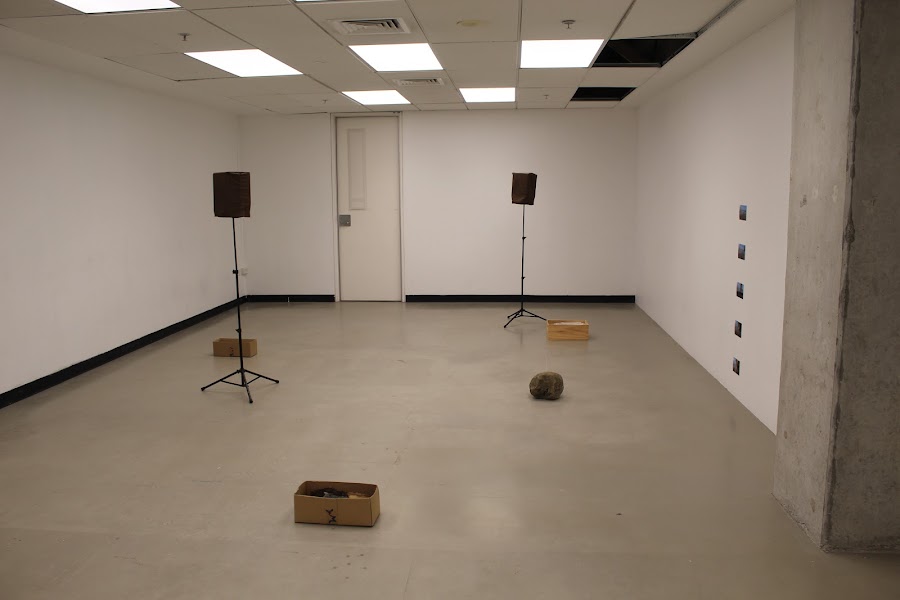
for my last work I wanted to install with a refining approach as I bring out ideas relating to taking from the land and the affect that I as a stone collector have on the things I have collect. As I mentioned in my previous work , this innocent act of collecting actually has a deep desire behind it. The act itself can take be seen in a negative light – relating to human greed.
I wonder if this innate collection quality that I find in myself and so many others has a greater significance is a subconscious place?
Yes, Indeed there is a subconscious behind every act we make in the world, collecting is no different in this regard. Through my research into the phycology’s behind collecting I found the concepts of time, fear and death to have the greatest connection behind my stone collection. perhaps, I collect as a way to hold onto memory- an act to capture a moment in time. Allowing the physicality of a rock to visualize the many memories that I collect throughout my life. Do I fear losing my memories?
This discussion of personal ways that I exist in the world and make sense of time and place outside of the conscious mind is not the only context to be considered.
Rocks carry a history longer that I could ever hope to experience. (Yes, I am personifying the stones within my collection.) The memories that a rock holds may easily be overlooked by the collector. In this overlooking the collector sees greater value in the memories that they hold over the memories that rock holds throughout it’s lifetime.
In this final install I explore who hold value over who? Does the rock speak louder than the collector’s dominance or does the collector hold dominion over the lasting history of a rock and its ability to hold memory.
Installing I want to draw from my previous work as I assembles different point of contact for an audience member to hold perspective from.
I have brought together aspects from my previous works, refining their impact within the overall impact of the installation. Introducing two sounds playing into the space, I have extended the use of the personified speaker. The two speakers are placed at a opposing ends facing each other. I measured using my feet = 6 out and 7 in. One speaker represents the collectors sound and the other is the sound from the stones.
To begin with I wanted to he sound of the collector to show an obnoxious sound over the sound of the silent stones. Though as I refined my work – giving the stones there own sense of pace and anticipation allowed the sound coming form the collector (Walking along the beach to running along the beach)
This tile grasps the irony of memory in relation to the space between the collector and the collection. The stone capture a memory that serves the collector, hence it is apart of the collection. At the same time the collector can be seen as a criminal capturing the land.
LANDNAPPING
Defined: To capture the land.- Word takes after the term ‘kidnapping.’
I have created this word, ‘landnapping’ to articulate the possible role that the collector plays. Or should I say landnapper?
 BRITNEY SAYWELL